From Mosaic to AI: 30 Years of Building for the Web
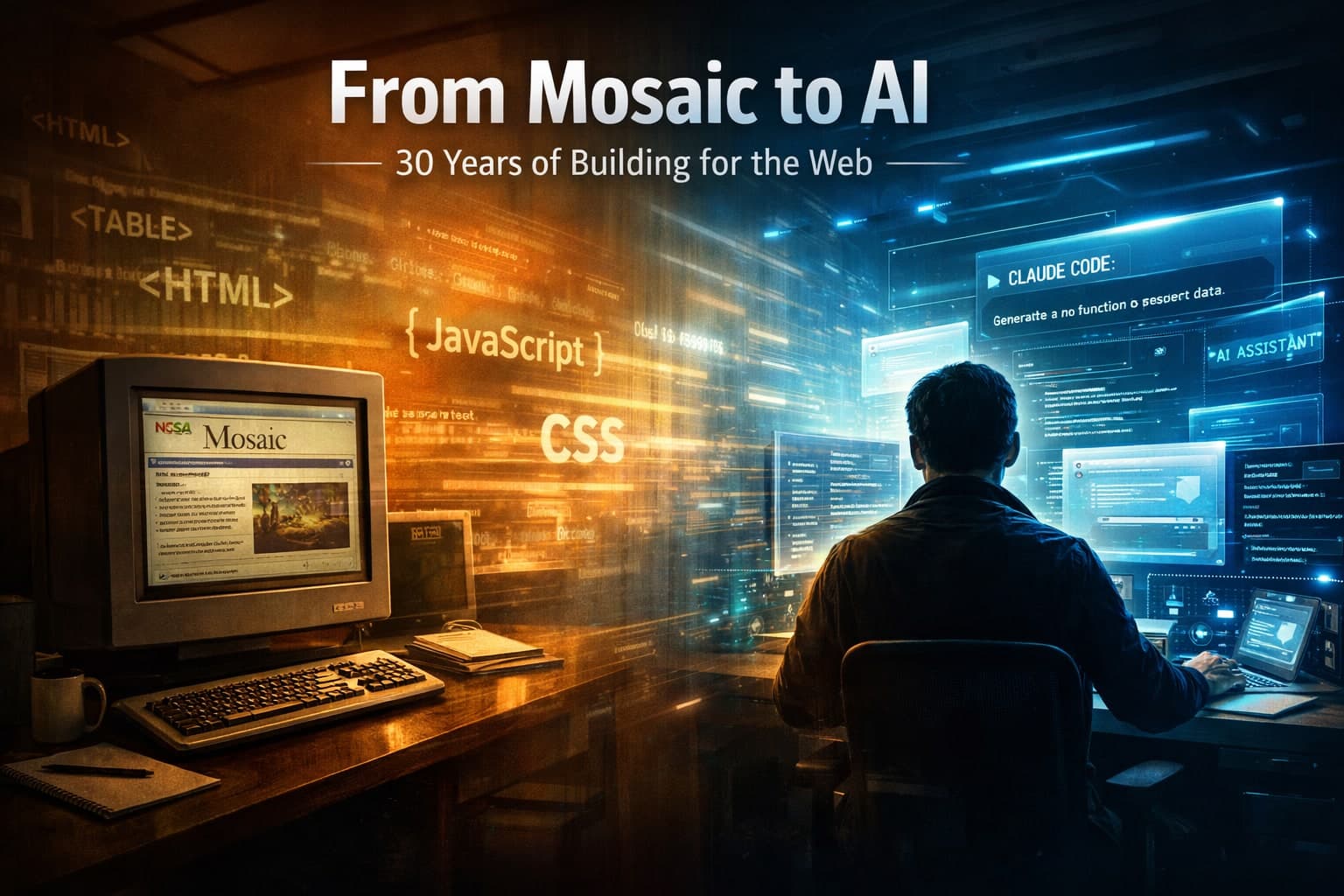
In 1995, I was finishing up my degree at the University of Wisconsin-Stout when I spotted something strange in a magazine — a URL. I had no idea what it was.
I asked a friend — a math major — what he thought. He told me it was a web address, something you could type into a "web browser" to see a page on the internet. I didn't understand a word of it. So I asked him to show me.
He took me to the computer lab in the math department and introduced me to the Mosaic web browser. The moment that first page loaded, I was hooked.
Learning the Hard Way
I spent the next five years pouring every spare moment into teaching myself HTML, then JavaScript, and eventually CSS. There were no bootcamps, no YouTube tutorials — just source code, trial and error, and an obsession with figuring out how it all worked.
The Dot-Com Years and Starting Aslan Interactive
By the early 2000s, I'd turned that obsession into a career, working as a web developer at a string of dot-com startups during the boom. Then in 2003, my business partner Jason McKinney and I founded Aslan Interactive. Building web applications that could do real, meaningful things for people — that was the thrill. Every project felt like new territory. The technology was moving fast, and so were we.
That Feeling Again
Fast forward to late 2025. The arrival of Claude Code and the new generation of AI coding agents feels like that moment in the computer lab all over again — that same jolt of possibility.
But it's not just about writing code faster. What's truly changed is the ability to orchestrate. I can spin up multiple AI agents working in parallel — one building a component, another writing tests, another refactoring an API — and coordinate them toward a shared goal. The role has shifted from writing every line by hand to directing an ensemble of intelligent tools, each one capable of handling complex tasks autonomously.
And it goes beyond coding. Automation that used to take days of scripting and configuration now comes together in minutes. Connecting services, setting up workflows, generating documentation, managing deployments — the entire lifecycle of building and running software is being reshaped. The developer's job is becoming less about syntax and more about systems thinking, architecture, and orchestration.
After thirty years of building for the web, the craft is transforming in ways I couldn't have predicted. And just like in 1995, I'm hooked.
The tools have changed. The excitement hasn't.